
American art has shaped our national identity and cultural narrative through the centuries. From colonial portraits to modern abstracts, these masterpieces capture pivotal moments, cultural shifts, and the ever-evolving American spirit.
I put this list together based on a mix of cultural impact, art historical significance, and which paintings I’ve personally been most moved by in museums over the years. Some of these (American Gothic, Nighthawks) are so iconic they’ve transcended the art world entirely and become part of American visual language.
Others (like Portrait of Samuel Adams) represent pivotal moments in American history. A few are here because they fundamentally changed what American art could be – Pollock’s drip paintings, Warhol’s soup cans, Johns’ flags all broke rules and opened new doors.
And a couple are just paintings I think more people should know about. This isn’t meant to be the definitive academic canon – it’s the 16 American paintings I think are most impressive overall.
Where to See These Famous American Paintings
Art Institute of Chicago – American Gothic, Nighthawks, Mother’s Goodnight Kiss · The Metropolitan Museum of Art, New York – Washington Crossing the Delaware, Snap the Whip · Museum of Modern Art (MoMA), New York – Flag, Campbell’s Soup Cans · Tate Modern, London – Whaam!
If you’re planning to see these paintings in person, here’s what helped me at each museum. At the Art Institute of Chicago, American Gothic and Nighthawks are both in the American Art wing on the second floor – I’d budget at least 90 minutes just for that section if you want to really take your time.
The Met in New York is massive, so grab a map and head straight to the American Wing if these paintings are your priority (Washington Crossing the Delaware is hard to miss, it takes up most of a wall). MoMA gets incredibly crowded on weekends, so I’d suggest going on a weekday morning if you can – Flag and the Campbell’s Soup Cans are on the fifth floor.
And if you’re making the trip to Tate Modern in London for Whaam!, know that it’s in the Pop Art galleries, which rotate occasionally, so double-check the museum’s website before you go to make sure it’s on view.

1. American Gothic (1930) – Grant Wood
Grant Wood’s austere portrayal of a farmer and his daughter (often mistaken for his wife) standing before their Gothic Revival farmhouse has become one of the most recognizable images in American art. You can admire this unique painting at the Art Institute of Chicago. Arrive at opening on a weekday, and head straight to the most popular galleries before tour groups build up.
When I stood in front of this painting, I was struck by how small and intimate it feels compared to its massive cultural presence – the subjects’ stern expressions feel even more unsettling up close. Wood both celebrates and satirizes rural American values here, and the meticulous detail (you can see every wrinkle in the man’s overalls) became a symbol of Midwestern stoicism during the Great Depression.
While you’re there, don’t miss one of the finest Impressionist and Post-Impressionist collections outside Paris, including Seurat’s A Sunday on La Grande Jatte, Monet’s Stacks of Wheat and Van Gogh’s The Bedroom. The Thorne Miniature Rooms are a charming bonus.

2. Washington Crossing the Delaware (1851) – Emanuel Leutze
This monumental painting captures a pivotal moment in American history, depicting George Washington leading his troops across the Delaware River on Christmas night, 1776. While historically inaccurate in several details, Leutze’s dramatic composition created an enduring symbol of American leadership and determination.
The painting’s theatrical lighting and heroic poses established it as a cornerstone of American patriotic imagery.
The Met is one of the largest museums in the world, with art spanning 5,000 years. Weekday mornings are quietest, while evening openings are a calmer way to see the busiest galleries.
Set aside time for the Temple of Dendur, an ancient Egyptian temple rebuilt inside a glass-walled gallery, and the Arms and Armor galleries.

3. Nighthawks (1942) – Edward Hopper
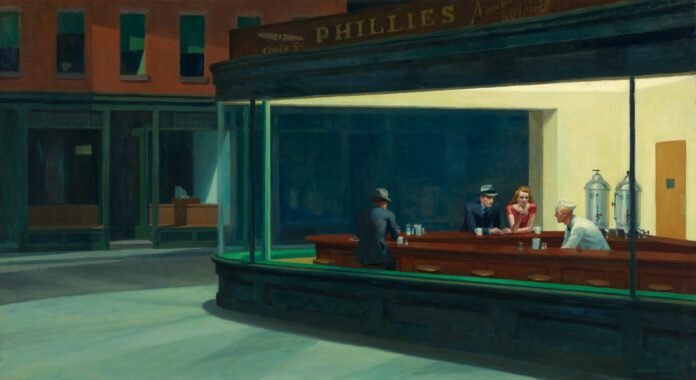
I could’ve stood in front of Hopper’s Nighthawks at The Art Institue of Chicago for an hour – there’s something hypnotic about the way he captures late-night isolation in a brightly lit diner. The stark contrast between the fluorescent interior and the pitch-black street outside, combined with the way the four people inside seem completely disconnected from each other despite being in the same small space, hits even harder now in our digital age when you can be surrounded by people and still feel completely alone.

4. Arrangement in Grey and Black No. 1 (1871) – James McNeill Whistler
Better known as ‘Whistler’s Mother,’ this portrait has become an icon of maternal dignity and American Victorian values. Despite being painted in London, its quiet power and restrained emotion have made it a symbol of American motherhood and familial devotion.
The formal composition and limited color palette demonstrate Whistler’s masterful technique.
The painting is housed at the Musée d’Orsay in Paris, a grand former Beaux-Arts railway station, though it occasionally travels for special exhibitions. This museum holds the world’s largest collection of Impressionist and Post-Impressionist masterpieces.
The view of Paris through its giant clock windows is worth the visit alone. Book a timed ticket in advance and aim for opening time or a late evening opening, as queues peak from late morning.

5. Portrait of Samuel Adams (1772) – John Singleton Copley
This defining portrait of the American Revolutionary leader captures Adams at the height of his influence. Copley’s realistic style and attention to detail create an intimate portrayal of the patriot, showing both his determination and contemplative nature.
This impressive artwork serves as both historical document and artistic achievement. The portrait is on view at the Museum of Fine Arts, Boston. The MFA is known for one of the largest Monet collections outside France, as well as outstanding Egyptian and Japanese art.
Weekday afternoons at the MFA tend to be relaxed, while weekends are busier with families and visitors.

6. Lake George Reflection (1922) – Georgia O’Keeffe
Georgia O’Keeffe’s “Lake George Reflection” captures the serene beauty of Lake George in upstate New York through her distinctive modernist style. The painting presents a mirror-like reflection of trees and foliage on the lake’s surface, rendered in deep blues and greens that blend into abstract forms.
O’Keeffe’s characteristic simplification of natural shapes creates a nearly symmetrical composition, with the water’s surface acting as a horizontal dividing line. The work exemplifies her ability to find abstract patterns within nature while maintaining a strong connection to the physical landscape that inspired her.
This painting is in a private collection but you can see similar ones from the series at the San Francisco Museum of Modern Art (SFMOMA) and the Georgia O’Keeffe Museum in Santa Fe. The latter boasts the largest collection of O’Keeffe’s work anywhere.
Book timed tickets ahead, especially in summer, and plan a weekday visit if you can. You can also book a tour of her home and studio in Abiquiú, about an hour’s drive north, to see the landscapes that inspired her later paintings.

7. Sunset in the Rockies (1865) – Albert Bierstadt
Bierstadt’s dramatic landscape captures the sublime grandeur of the American West. His luminous technique and romantic vision helped shape the American understanding of frontier landscapes, while inspiring support for wilderness preservation.
The imposing landscape painting exemplifies the Hudson River School’s celebration of American natural beauty. This work is in a private collection. For Bierstadt’s Rocky Mountain scenery on public view, see The Rocky Mountains, Lander’s Peak at The Metropolitan Museum of Art in New York.

8. Portrait of George Washington and William Lee (1780) – John Trumbull
Trumbull’s portrait presents Washington as a victorious commander, combining military dignity with simplicity. The painting combines military dignity with simplicity, establishing the visual template for presidential portraiture.
The politician is depicted with his military aide and valet, William Lee. Washington freed him in his will and left him an annuity.
The portrait is part of the collection at The Metropolitan Museum of Art in New York.

9. Snap the Whip (1872) – Winslow Homer
Homer’s vibrant depiction of boys playing in a rural schoolyard captures the essence of post-Civil War American childhood. The painting’s dynamic composition and attention to light and movement demonstrate Homer’s mastery while documenting a simpler era in American life.
View this iconic American painting at The Metropolitan Museum of Art in New York City. Founded in 1919, the Butler is known as the first museum in the US dedicated exclusively to American art.

10. Flag (1954) – Jasper Johns
After dreaming of the American flag, Jasper Johns made this groundbreaking work when he was just 24 years old. Created using encaustic, oil paint, and newspaper collage on canvas, the piece challenges viewers to see this familiar symbol as both an icon and a pure artistic form.
Johns’ meticulous layering technique and textural treatment blur the line between representation and abstraction, while his use of newsprint visible beneath the surface adds depth and cultural commentary. The work marked a pivotal shift from abstract expressionism toward pop art and conceptualism.
When we last visited MoMa, we were surprised to encounter the Joker right next to this painting! He does match it well though…
MoMA is home to many of the most famous works of modern art, including Van Gogh’s The Starry Night, Picasso’s Les Demoiselles d’Avignon, Dalí’s The Persistence of Memory and Monet’s Water Lilies. The Abby Aldrich Rockefeller Sculpture Garden is a peaceful spot to pause between galleries.

11. Campbell’s Soup Cans (1962) – Andy Warhol
Warhol’s series of 32 paintings featuring Campbell’s Soup cans revolutionized American art by elevating commercial products to fine art status. This work became a defining statement of Pop Art, questioning the boundaries between high art and popular culture.
See this series at The Museum of Modern Art (MoMa) in New York City. We were impressed with how many Warhol’s were on display. Go at opening on a weekday and visit the fifth-floor galleries (home to The Starry Night) first, before they fill up.

12. Mother’s Goodnight Kiss (1888) – Mary Cassatt
Cassatt’s intimate portrayal of maternal care combines American sentiment with French Impressionist technique. The painting’s tender subject matter and sophisticated composition demonstrate her unique ability to elevate domestic scenes to high art.
The painting is on permanent display in Gallery 184 at The Art Institute of Chicago.

13. Portrait of Madame X (1884) – John Singer Sargent
Though painted in Paris, this provocative portrait of American expatriate Virginie Gautreau scandalized society while establishing Sargent’s reputation. Its elegant pose and subtle psychology make it a masterpiece of portraiture.
Madame X is on display at The Metropolitan Museum of Art in New York.

14. Whaam! (1963) – Roy Lichtenstein
Lichtenstein’s massive comic book-inspired painting perfectly captures the drama and energy of 1960s Pop Art. Its bold colors and Ben-Day dots created a new visual language for American art, bridging high art and popular culture.
This unique artwork is usually on display at Tate Modern in London, UK. The curators do rotate the art displays quite frequently, which keeps things interesting but if there’s a particular painting you’re keen to see, it’s worth contacting them beforehand to check if it’s currently being displayed.
Set in the former Bankside Power Station on the Thames, Tate Modern offers free entry to its collection displays. Look out for the vast installations in the Turbine Hall, then head up to the viewing level for panoramic views across London.
Weekday mornings are calmest, while weekends and school holidays bring the biggest crowds to the free displays.

15. Autumn Rhythm (Number 30) (1950) – Jackson Pollock
Pollock’s revolutionary drip painting technique created a new form of artistic expression. This massive canvas exemplifies Abstract Expressionism’s emphasis on process and spontaneity, marking a decisive break with traditional painting methods.
You can see it at The Metropolitan Museum of Art in New York City.

16. LOVE – Robert Indiana
Robert Indiana’s “LOVE” became one of the most iconic works of pop art through its bold, deceptively simple design. The piece features the letters L, O, V, and E stacked in a square formation, with the O tilted at an angle, rendered in vibrant colors.
Originally designed as a Christmas card for the Museum of Modern Art, the image proliferated through sculptures, prints, and stamps, becoming a symbol of 1960s idealism. It was also a pioneering example of text-based art that blurred the lines between fine art and commercial design.
We’ve been fortunate to see Indiana’s LOVE artworks in Naples, Florida, at Tate Modern in London and also more recently in Taipei. There’s a bright red LOVE sculpture just in front of the Taipei 101 Tower.

17. Seagram Murals (1958–1959) – Mark Rothko
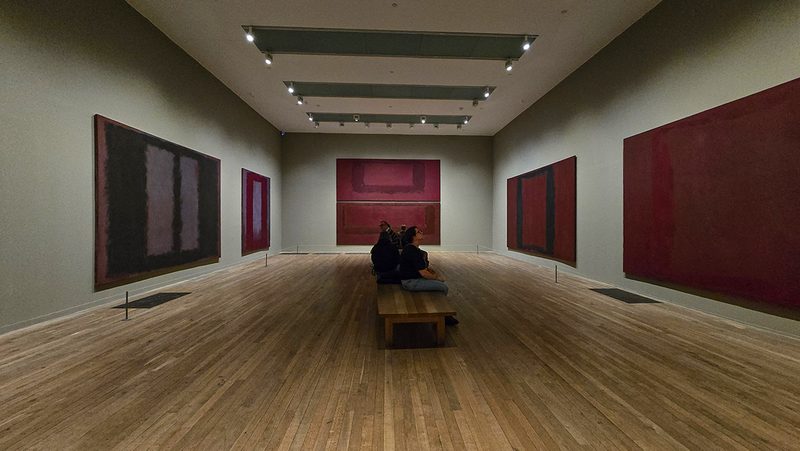
In 1958, Mark Rothko accepted a commission to paint a series of large murals for the Four Seasons restaurant in New York’s Seagram Building. He built a scaffold in his studio to match the exact dimensions of the dining room so he could work at full scale.
The Seagram Murals marked a dramatic shift for the Russian-born American artist. Rothko replaced the bright, glowing colors of his earlier work with deep maroons, dark reds and black, creating brooding canvases designed to envelop the viewer.
After a trip to Europe in 1959, Rothko decided that a fashionable restaurant was the wrong setting for his paintings and withdrew from the commission. He later gave nine of the murals to Tate, partly because of his admiration for J.M.W. Turner.
Today, you can experience the murals as Rothko intended, hung together in a dimly lit room at Tate Modern in London. Entry is free, and it’s one of the most popular rooms in the museum. With regards to our earlier tip about some Tate artworks being in the archives when you visit, you don’t need to worry about these – they’re permanently displayed in the Rothko Room on Level 2.
Related reading:
Frequently Asked Questions About Famous American Paintings
What is the most famous American painting?
American Gothic by Grant Wood is arguably the most famous American painting. Painted in 1930, this iconic image of a farmer and his daughter standing before a Gothic Revival farmhouse has become one of the most recognizable artworks in the world.
It’s housed at the Art Institute of Chicago, where you can see it in person year-round as part of their permanent collection.
Where can I see American Gothic in person?
You’ll find American Gothic at the Art Institute of Chicago in Gallery 263. The museum displays it prominently in their American art galleries on the second floor.
I recommend visiting on weekday mornings when crowds are lighter—this painting draws huge crowds, and you’ll want time to really take in the details without someone’s selfie stick in your face.
What museums have the most famous American paintings?
The Metropolitan Museum of Art in New York has the largest collection, including Washington Crossing the Delaware and several Winslow Homer masterpieces. The Art Institute of Chicago comes in second with American Gothic and Nighthawks.
The Museum of Modern Art (MoMA) in New York houses Christina’s World and multiple Abstract Expressionist works. If you’re planning an American art tour, these three institutions should top your list.
Who painted Washington Crossing the Delaware?
Emanuel Leutze painted Washington Crossing the Delaware in 1851. Interestingly, Leutze was a German-American artist who actually painted this iconic American scene in Düsseldorf, Germany.
The original hangs in the Metropolitan Museum of Art in New York, where it commands an entire wall in the American Wing – it’s absolutely massive in person, measuring 12 feet by 21 feet.
Where is Nighthawks by Edward Hopper located?
Nighthawks is permanently displayed at the Art Institute of Chicago. Painted in 1942, this late-night diner scene captures urban isolation like nothing else.
You’ll find it in the same galleries as American Gothic, making the Art Institute a must-visit if you want to knock out two of America’s most famous paintings in one trip.
What painting style are most famous American paintings?
American paintings span several major movements. You’ve got American Realism (think Winslow Homer and Edward Hopper), Regionalism (Grant Wood’s American Gothic), Abstract Expressionism (Jackson Pollock and Mark Rothko), and Pop Art (Andy Warhol).
Unlike European art that evolved over centuries, American painting compressed all these movements into about 150 years, giving us this incredibly diverse artistic heritage.
Can you see famous American paintings for free?
Yes! Many museums with famous American paintings offer free admission days. The National Gallery of Art in Washington, D.C. is always free and houses works by Gilbert Stuart and Winslow Homer.
The Smithsonian American Art Museum is also free year-round. Major museums like the Met and Art Institute offer “pay what you wish” hours or free days for residents – check their websites before visiting.
Why is American Gothic so famous?
American Gothic became famous because it captured something quintessentially American—that stoic, hardworking Midwestern spirit – right as the Great Depression hit. Grant Wood entered it in a competition at the Art Institute of Chicago in 1930, won third place and $300, and it’s been an cultural icon ever since. The painting’s been parodied thousands of times, which only amplified its fame. Standing in front of it, you realize how perfectly Wood nailed those expressions.

